MOU AND CONTRACT: DIFFERENCES BEYOND THE NAME
A Memorandum of Understanding (MOU) and a Contract are two types of documents frequently encountered in commercial activities, investment, business cooperation, and mergers and acquisitions (M&A). However, not all businesses fully understand the legal nature and binding force of these documents.
In practice, MOUs are often used to record initial agreements, while contracts are used when parties have agreed upon transaction terms and wish to establish specific rights and obligations.
This usage leads to a relatively common perception: MOUs are merely expressions of goodwill, while only contracts have legal validity.
However, from the perspective of Vietnamese law, this understanding is not entirely accurate.
A document named MOU can still give rise to legally binding rights and obligations. Conversely, the mere naming of a document as a "Contract" does not automatically guarantee its validity if it does not meet legal requirements.
The crucial difference lies not only in the name but also in the purpose of execution, the content of the agreement, the level of commitment, and the true legal intent of the parties.
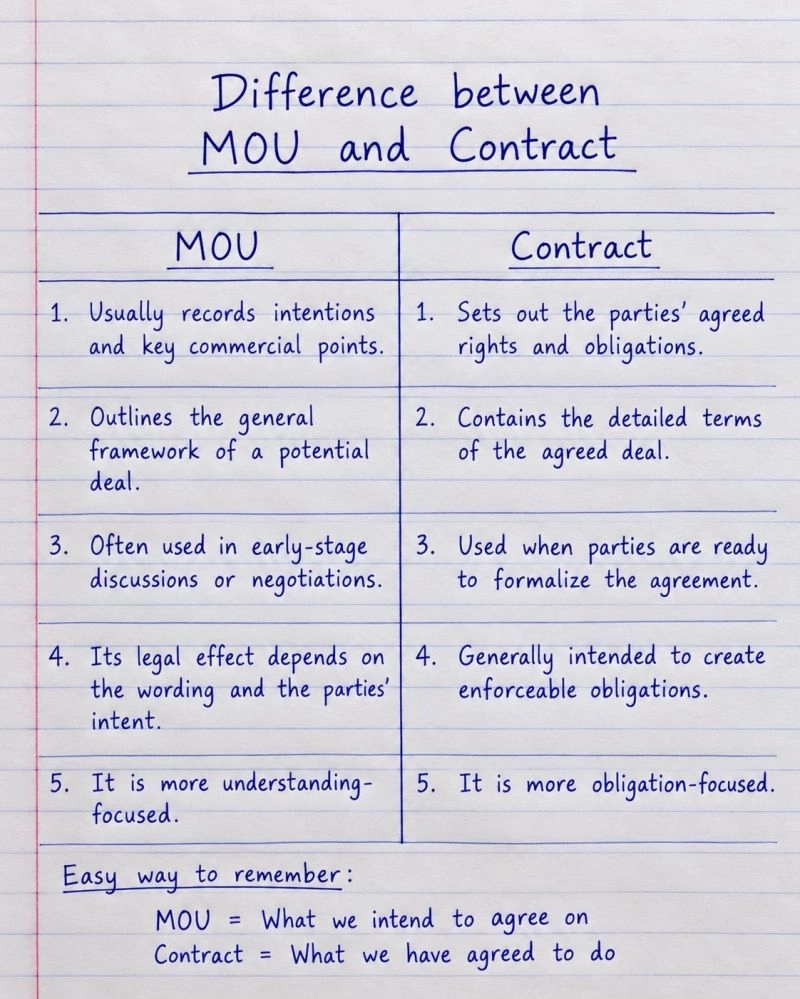
1. What are MOU and Contract?
1.1. MOU – Memorandum of Understanding
An MOU (Memorandum of Understanding) is a document typically used by parties to record common understandings, principles of cooperation, or preliminary commercial terms related to a prospective transaction.
In business operations, an MOU can be used to:
-
Define the objectives and scope of cooperation.
-
Record commercial terms that have been discussed.
-
Establish a basis for negotiating and signing a formal contract.
-
Delineate the responsibilities of the parties during the transaction preparation phase.
-
Establish certain specific commitments such as confidentiality, exclusivity in negotiations, or cost sharing.
For example, two companies planning to cooperate in building a factory might sign an MOU recording the projected investment scale, capital contribution ratios, profit-sharing principles, and implementation roadmap.
At the time of signing the MOU, the parties may not have completed legal due diligence, precisely determined the investment value, or agreed on all conditions for project implementation.
In this case, the MOU serves as a guiding document for the cooperation process.
However, an MOU is not a distinct type of contract specifically defined by the Civil Code 2015 with a separate general legal regime. Determining the legal validity of an MOU requires consideration of its specific nature and content.
1.2. Contract
According to Article 385 of the Civil Code 2015:
"A contract is an agreement between parties regarding the establishment, modification, or termination of civil rights and obligations."
In essence, a contract is a legal tool that transforms the convergence of wills between parties into specific rights and obligations.
A commercial contract typically defines matters such as the subject of the transaction, contract value, payment terms, performance period, responsibilities of the parties, and mechanisms for handling breaches.
For instance, for an equipment purchase contract, the parties need to clarify:
-
What equipment is being bought and sold, with what quantity and technical standards?
-
How are the purchase price and payment terms determined?
-
How are the time of delivery, transfer of ownership, and transfer of risk determined?
-
Which party is responsible for transportation, installation, acceptance, and warranty?
-
How will issues be handled if the equipment is not up to standard or delivery is delayed?
These clauses not only describe the transaction but also allocate duties, responsibilities, and risks between the parties.
A contract is therefore not merely a document recording an agreed-upon transaction, but also a legal mechanism to organize its execution and protect the legitimate interests of the parties.
2. Key Differences Between MOU and Contract
| Criterion |
MOU |
Contract |
| Purpose of Use |
Often records directions, principles, and initial agreements |
Establishes specific rights and obligations between parties |
| Stage of Use |
Typically appears during the contact, negotiation, or transaction preparation phase |
Usually signed when parties have agreed on transaction terms |
| Content |
May only include basic commercial terms |
Typically specifies details of the subject matter, payment, performance, and responsibilities |
| Binding Nature |
May be non-binding, partially binding, or fully binding |
Is binding when legally executed and effective |
| Level of Completion |
Some contents may continue to be negotiated |
Necessary contents for transaction execution are usually defined or have a mechanism for definition |
| Handling of Breach |
Depends on the binding obligations and relevant legal provisions |
Applies sanctions and remedies as agreed and by law |
| Relationship with Subsequent Documents |
Can serve as a basis for drafting a formal contract |
Can directly govern the transaction or be a framework agreement for subsequent transactions |
The comparison table above reflects common practical usage, not an absolute legal classification.
Notably, a master agreement or framework agreement may also only stipulate general matters, leaving specific conditions to be determined in individual purchase orders, appendices, or sub-contracts.
Therefore, one cannot solely rely on the level of detail in a document to conclude whether it is an MOU or a legally effective contract.
3. Does an MOU have legal validity?
This is the most important issue when considering the difference between an MOU and a contract.
According to Article 117 of the Civil Code 2015, a civil transaction is valid when it meets conditions regarding the parties, voluntariness, lawful purpose and content; and must also meet formal requirements if the law stipulates form as a condition for validity.
Combined with the definition of a contract in Article 385, it can be seen that the law evaluates an agreement based on its legal nature and conditions for validity, not just on the name of the document.
In practice, MOUs can be categorized into three cases.
3.1. MOU is non-binding regarding the prospective transaction
This is the case where parties only wish to record their intention to cooperate and do not yet want to establish a mandatory obligation to execute the main transaction.
For example:
Company A and Company B sign an MOU regarding research cooperation in manufacturing and distributing products in Vietnam.
The MOU records that the two parties intend to cooperate, revenue will be shared according to a ratio to be further negotiated, and formal terms will be determined in a contract signed after the due diligence process is completed.
The document also explicitly states that the commercial cooperation contents do not create mandatory obligations for execution.
In this situation, in principle, signing the MOU does not mean that Company A is obligated to invest or Company B is obligated to commence manufacturing activities.
The parties may still not proceed to the final transaction.
However, the fact that the MOU is non-binding regarding the main transaction does not mean that the parties are exempt from all legal obligations during the negotiation process. Obligations arising under legal provisions, especially the obligation to provide and keep information confidential under Article 387 of the Civil Code 2015, still need to be considered.
3.2. MOU is partially binding
This form is quite common in investment, joint venture, and M&A transactions.
The parties may not yet be obligatorily committed to executing the main transaction but have agreed on certain obligations that become effective upon signing the MOU.
For example:
Confidentiality: The parties commit not to disclose financial, commercial, technical information, or internal data provided during the due diligence process.
Exclusivity: For a specified period, the seller commits not to negotiate or enter into a similar transaction with another partner within the agreed scope.
Costs and Expenses: The parties determine which party bears the costs of legal consulting, due diligence, auditing, or other expenses arising from the transaction preparation process.
Dispute Resolution: The parties agree on a mechanism for resolving disputes arising from the binding clauses.
Thus, one party refusing to continue the main transaction does not necessarily constitute a breach of the MOU.
However, if that party breaches a valid confidentiality or exclusivity obligation, corresponding legal liability may still arise.
This shows that an MOU can fully serve as a guiding document for the main transaction while also containing commitments that are mandatory to perform.
3.3. MOU can be fully binding
This is a case where businesses need to be particularly cautious.
Suppose two businesses sign a document titled "Memorandum of Understanding for Asset Transfer."
The content of the document clearly defines:
-
List of assets to be transferred.
-
Total transaction value.
-
Payment schedule.
-
Timeframe and conditions for handover.
-
Obligations of the seller and the buyer.
-
Responsibility if one party fails to fulfill its commitments.
If the document expresses a convergence of wills regarding the establishment of specific rights and obligations, and also meets the conditions for validity, the MOU may be determined to be a contract or contain binding contractual agreements.
In such a case, a party cannot automatically invoke the reason that the document is named "MOU" to refuse to perform its obligations.
Conversely, if the MOU clearly stipulates that commercial terms are only prospective, the main transaction depends on the signing of a formal contract, or must meet other prerequisite conditions, then the conclusion regarding validity will be different.
The core legal issue is not whether the parties signed an MOU or a contract, but what obligations the parties have actually committed to perform, from what time, and under what conditions.
There is no single answer for all cases.
If the MOU only records goodwill for cooperation and the parties reserve the right not to proceed with the transaction, generally, not signing a formal contract does not automatically constitute a breach of the obligation to execute the main transaction.
However, if the MOU contains a binding commitment to sign a contract or execute a transaction when specific conditions are met, refusing to sign may give rise to legal liability depending on the content, legality, and feasibility of the commitment.
Three concepts need to be distinguished:
First, commitment to continue negotiations. Parties have an obligation to participate in the negotiation process within the agreed scope, but this does not necessarily mean an obligation to reach a final agreement.
Third, commitment to formally execute the main transaction. Where rights and obligations have been established and are effective, subsequent contract signing may merely serve to specify the method of execution or meet necessary legal requirements.
Specifically, an MOU creating an obligation to transfer does not automatically mean that ownership of assets or the rights of shareholders or capital contributors have been transferred.
For transactions with specific requirements regarding form, approval, registration, or transfer procedures, parties must still comply with specialized laws.
5. Common Legal Risks When Using MOUs
5.1. Failure to Clearly Define Binding Clauses
An MOU may begin with the statement "The Parties wish to cooperate" but later clauses use phrases such as "Party A has the obligation," "Party B must pay," or "The breaching Party must compensate."
This inconsistency can lead to disputes regarding the nature of the document.
When interpreting a contract, Article 404 of the 2015 Civil Code requires consideration not only of the wording but also of the parties' intent during the pre-contractual, formation, and execution stages.
Therefore, the title or a general declaration clause may not resolve all inconsistencies within the document's content.
5.2. Payment Before Clearly Defining Legal Nature
In many transactions, especially business acquisitions, machinery, equipment, or asset purchases, parties may agree to pay an amount immediately after signing an MOU.
The question arises: what is the legal nature of this payment?
It could be a deposit to secure the conclusion or performance of the contract, an advance payment for the transaction value, or a security deposit governed by a separate agreement.
Classification is particularly important because each type of payment can lead to different legal consequences.
For instance, regarding deposits, Article 328 of the 2015 Civil Code stipulates the mechanism for handling deposited assets when one party refuses to conclude or perform the contract, unless otherwise agreed by the parties.
In contrast, an advance payment is not automatically subject to the same handling mechanism as a deposit.
Therefore, parties need to clearly define the purpose of the payment, conditions for refund, cases for deduction, and responsibility if the transaction is not continued.
5.3. Proceeding with Transactions Before Fulfilling Legal Conditions
In practice, businesses sometimes begin payments, asset transfers, document handovers, or operational activities immediately after signing an MOU.
This can give rise to numerous risks:
-
Failure to determine the time of ownership transfer and risk transfer.
-
Absence of a mechanism for asset acceptance or confirmation of obligation fulfillment.
-
Failure to complete approval procedures or transfer of rights as required.
-
Failure to determine liability if the formal contract is not signed.
-
Absence of a mechanism for handling assets, information, or funds already exchanged.
The risk is greater for transactions involving multiple types of assets such as real estate, vehicles, machinery, intellectual property rights, or shares/contributed capital.
Using a general MOU cannot replace all specific legal requirements applicable to each transaction object.
Another often overlooked issue is the relationship between an MOU and a subsequently signed contract.
If the two documents have conflicting content, which document takes precedence?
Do confidentiality obligations, exclusive negotiation rights, or payments arising from the MOU continue to exist?
If the formal contract does not address these issues, disputes may arise regarding the validity of prior agreements.
Businesses should clearly determine whether the formal contract entirely supersedes the MOU, only partially supersedes it, or maintains the validity of certain specific clauses.
6. Should Businesses Use an MOU or a Contract?
The choice of document should stem from the nature and completeness of the transaction.
Use an MOU When the Transaction is Still in the Preparation Phase
An MOU is often suitable when parties have only agreed on the general direction of cooperation, need more time for due diligence, or still need to negotiate key terms.
For example, in an M&A deal, the investor and seller may agree on valuation principles, due diligence scope, exclusivity period, and anticipated conditions to proceed with the transaction.
An MOU helps establish a basis for negotiation without necessarily obligating the parties to complete the sale.
Use a Contract When Specific Rights and Obligations Need to Be Established
When commercial terms have been determined and parties wish to establish specific commitments, a contract is usually the more appropriate instrument.
For a sale and purchase agreement, businesses need a mechanism to define the subject matter, price, payment, delivery, acceptance, warranty, and remedies for breach.
For investment or capital transfer agreements, particular attention should be paid to preconditions, approval authority, rights and obligations of the parties, transaction completion mechanisms, and consequences if the transaction cannot be executed.
For long-term cooperation, businesses can use a framework agreement or master agreement to establish general terms, then implement them through corresponding contracts, purchase orders, or appendices.
Not every transaction is required to go through an MOU phase before signing a contract.
Similarly, a transaction does not necessarily require a document named "formal" contract if rights and obligations have been legally established by a valid agreement.
7. Issues to Check Before Signing an MOU
From a legal governance and risk control perspective, businesses should focus on the following contents:
1. Purpose of the document: Does the MOU merely record an intention to cooperate or does it establish an obligation to perform the transaction?
2. Scope of bindingness: Is the entire content legally binding or only certain clauses?
3. Issues still to be negotiated: What issues have been agreed upon and what issues need to be defined in the subsequent contract?
4. Conditions for implementation: Is the transaction dependent on due diligence results, internal approvals, consent from competent authorities, or other conditions?
5. Payments made: What is the legal nature of the payment and how will it be handled if the transaction is not completed?
6. Term and termination: How long is the MOU valid, under what circumstances can parties terminate it, and which obligations continue to exist after termination?
7. Authority to sign: Does the signatory have sufficient authority to represent or is duly authorized to establish the commitments?
8. Dispute resolution mechanism: Are the governing law, dispute resolution body, and legal consequences of breaching obligations appropriately defined?
For an MOU not intended to bind the parties to perform the main transaction, parties may consider a clause such as the following:
“Except for clauses expressly identified as legally binding, this Memorandum of Understanding is intended solely to record the initial principles and directions of cooperation between the Parties, and does not create an obligation for any Party to conclude a formal Contract or complete the contemplated Transaction. Rights and obligations related to the performance of the main Transaction shall only arise under the terms agreed upon by the Parties in the formal Contract and in accordance with applicable law.”
This is merely a reference clause. When used in practice, this content must be adjusted to be consistent with the entire MOU, the characteristics of the transaction, and the obligations that the parties genuinely wish to establish.
8. Conclusion: Legal Value is Determined by Content, Not Title
MOUs and Contracts often serve different purposes in business operations.
An MOU helps parties define their cooperative relationship, agree on principles, and prepare for a future transaction. Meanwhile, a contract is typically used to establish and regulate specific rights and obligations when executing a transaction.
However, the line between the two types of documents is not always clear.
An MOU may not be binding on the main transaction, may be partially binding, or may be considered a binding contractual agreement if its content and corresponding legal conditions are met.
Conversely, a document named a contract may not be valid if it does not comply with mandatory legal conditions.
Therefore, the crucial question before signing is not "Is this an MOU or a Contract?", but rather "What rights, obligations, and legal risks is this document creating for the business?".
In commercial and investment activities, reviewing a document should not stop at its wording or title. The entire transaction structure, participating parties, subject matter, execution conditions, and legal consequences of each commitment must be considered.
This is also an approach that helps businesses protect their rights, limit disputes, and control risks from the negotiation stage.
OPLAW – Corporate & Commercial Legal Services
OPLAW assists businesses in legal consulting, drafting and reviewing contracts, structuring commercial, investment, and M&A transactions.
Legal Basis for Reference:
-
Civil Code No. 91/2015/QH13: Articles 116, 117, 119, 328, 385, 387, 398, 400, 401, and 404.
-
Commercial Law No. 36/2005/QH11 and related amending and supplementing provisions.
-
Specialized legal provisions applicable to each specific transaction.
This article provides general legal knowledge and does not substitute for specific legal advice regarding a particular transaction.
Related articles
Frequently Asked Questions
What should readers know about MOU AND CONTRACT: DIFFERENCES BEYOND THE NAME?
Memorandum of Understanding (MOU) and Contract are two types of documents frequently encountered in commercial activities, investment, business cooperation, and mergers and acquisitions (M&A). However, not all businesses fully understand the legal nature and binding force of these documents.
What should readers know about MOU AND CONTRACT: DIFFERENCES BEYOND THE NAME?
Memorandum of Understanding (MOU) and Contract are two types of documents frequently encountered in commercial activities, investment, business cooperation, and mergers and acquisitions (M&A). However, not all businesses fully understand the legal nature and binding force of these documents.
What should readers know about MOU AND CONTRACT: DIFFERENCES BEYOND THE NAME?
Memorandum of Understanding (MOU) and Contract are two types of documents frequently encountered in commercial activities, investment, business cooperation, and mergers and acquisitions (M&A). However, not all businesses fully understand the legal nature and binding force of these documents.
What should readers know about MOU AND CONTRACT: DIFFERENCES BEYOND THE NAME?
Memorandum of Understanding (MOU) and Contract are two types of documents frequently encountered in commercial activities, investment, business cooperation, and mergers and acquisitions (M&A). However, not all businesses fully understand the legal nature and binding force of these documents.
What should readers know about MOU AND CONTRACT: DIFFERENCES BEYOND THE NAME?
Memorandum of Understanding (MOU) and Contract are two types of documents frequently encountered in commercial activities, investment, business cooperation, and mergers and acquisitions (M&A). However, not all businesses fully understand the legal nature and binding force of these documents.
Get legal advice tailored to your needs.
Contact us