WHAT DOES IN-HOUSE LEGAL ACTUALLY DO?
Many people new to the profession often think that in-house legal primarily involves reading laws, drafting contracts, and reviewing documents.
However, in reality, the role of Legal within a business is much broader.
Legal doesn't just answer the question:
"What do the legal regulations say?"
But also has to help the business answer:
"What are the risks – how do they impact us – and how do we manage them?"
The work of In-house Legal can be viewed through 7 main groups:
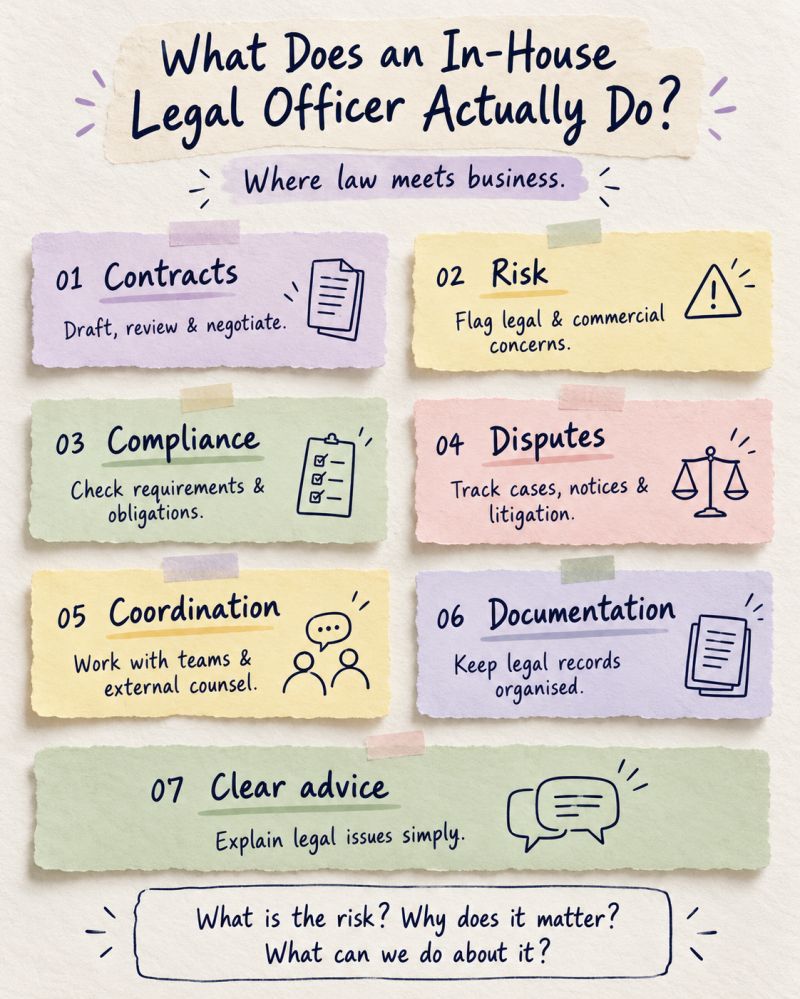
1. Contracts
Contract review is not simply about reading each clause and identifying unfavorable terms. The first step is to understand the nature of the transaction and the type of contract being used.
Legal should first identify:
- Is this a sale and purchase agreement, service agreement, distribution agreement, agency agreement, manufacturing agreement, license agreement, asset transfer agreement, or a hybrid structure?
- Who are the contracting parties? Do they have the appropriate legal capacity and authority to enter into the transaction?
- What mandatory legal requirements apply to this type of agreement?
- What are the actual commercial objectives of the parties?
- How do money, goods, assets, ownership or usage rights move between the parties?
Once the transaction structure is understood, Legal can then focus on the key issues specific to that type of contract.
For example:
Sale and purchase agreements: delivery, acceptance, transfer of title, transfer of risk, warranties, defective goods and Incoterms.
Service agreements: scope of work, deliverables, SLA/KPI, acceptance procedures, dependencies between the parties and liability for failure to meet agreed outcomes.
Distribution agreements: territory, exclusivity, minimum purchase commitments, pricing, inventory, channel conflict, termination and treatment of remaining stock.
License/IP agreements: scope of licensed rights, territory, term, exclusivity, sublicensing, royalties and ownership of newly created IP.
Legal can then assess:
How are rights and obligations allocated? Where does the risk sit? Which provisions do not align with the nature of the transaction or the operational reality of the business?
Good contract review therefore requires more than legal knowledge. It also requires an understanding of transaction structure, commercial practice and the specific issues inherent in each type of agreement.
2. Risk – Identification and Assessment
Not all legal issues have the same level of importance.
Legal needs to determine:
Risk → Impact → Probability → Mitigation
Meaning:
- What risks could arise?
- If they occur, what is the impact?
- Is the probability high or low?
- Are there measures to mitigate them?
A good Legal professional is not the one who can list the most risks.
More importantly, it's knowing which risks are truly material to the business.
3. Compliance – Turning Regulations into Processes
Compliance is not merely checking if the business is "in accordance with the law."
Legal also has to transform legal requirements into an operational system:
Law → Policy → Process → Control → Evidence
For example, if the law requires the business to perform a reporting obligation.
Legal must then determine:
Who is responsible?
When must it be performed?
Who approves?
Where are records stored?
How are warnings issued if there's a delay?
This is where Legal strongly intersects with Governance and Internal Control.
4. Disputes – Managing Disputes
Not all disputes need to go to court.
Legal's role often begins before that:
- Reviewing complaints;
- Preparing notices;
- Gathering documents and evidence;
- Assessing exposure;
- Working with external counsel;
- Supporting negotiation or litigation options.
The key is to balance between:
Legal position and commercial outcome.
Sometimes winning a legal dispute is not necessarily the best business option.
5. Coordination – Legal Cannot Work Independently
Legal almost always has to work with the entire business:
Sales – Finance – HR – Operations – IT – Management – External Counsel.
To provide accurate advice, Legal must understand how the business operates.
A contract clause might be legally perfect, but if Operations cannot implement it, it's still not a good clause.
Therefore, in-house Legal needs to understand not only law, but also business model and operational reality.
6. Documentation – Managing Legal Records
Legal documentation is often seen as administrative work, but in reality, it is part of the legal control system.
For example:
- Contracts;
- Licenses;
- Corporate records;
- Legal opinions;
- Notices;
- Dispute files;
- Regulatory/compliance records.
A business with well-managed legal records significantly reduces risk when:
audit, due diligence, regulatory inspection or dispute occurs.
7. Legal Advice – The Most Important Skill
In my opinion, this is the most underestimated skill.
Business doesn't need Legal to recite entire statutes.
They need a clear answer:
What is the risk?
Why does it matter?
What can we do about it?
A Legal professional might research a 10-page memo.
But ultimately must be able to tell Management in a few lines:
This is the issue.
This is the level of risk.
These are the available options.
These are the control measures if the Company wishes to proceed.
That is the difference between knowing the law and doing Legal for a business.
In-house Legal is therefore not merely a "legal check" department.
The role of Legal lies at the intersection of:
LAW × RISK × BUSINESS × GOVERNANCE
And the ultimate goal is not to eliminate all risks — because business always involves risks.
But rather to help the business correctly identify, understand, and manage risks at an acceptable level to make better decisions.